Federal Scholarship Tax Credits
WHAT COLORADO RURAL DISTRICTS NEED TO KNOW
A practical look at how scholarship-granting organizations could help rural districts remove cost barriers and expand student access.
Informational Purposes Only
This recorded webinar and the accompanying materials are not legal or financial advice. These materials are strictly nonpartisan. Commentary does not constitute a political endorsement. These materials are designed only to provide factual information for education professionals and learning communities in Colorado State. Federal guidance was still being finalized at the time of recording, and some implementation details may change. Information reflects the facts as they are understood as of July 2026.
WATCH THE RECORDING
Colorado SGO Briefing
BRIEFING RESOURCES
Get the Colorado SGO Brief Document
Federal Scholarship Tax Credits
What Colorado Rural Districts Need to Know
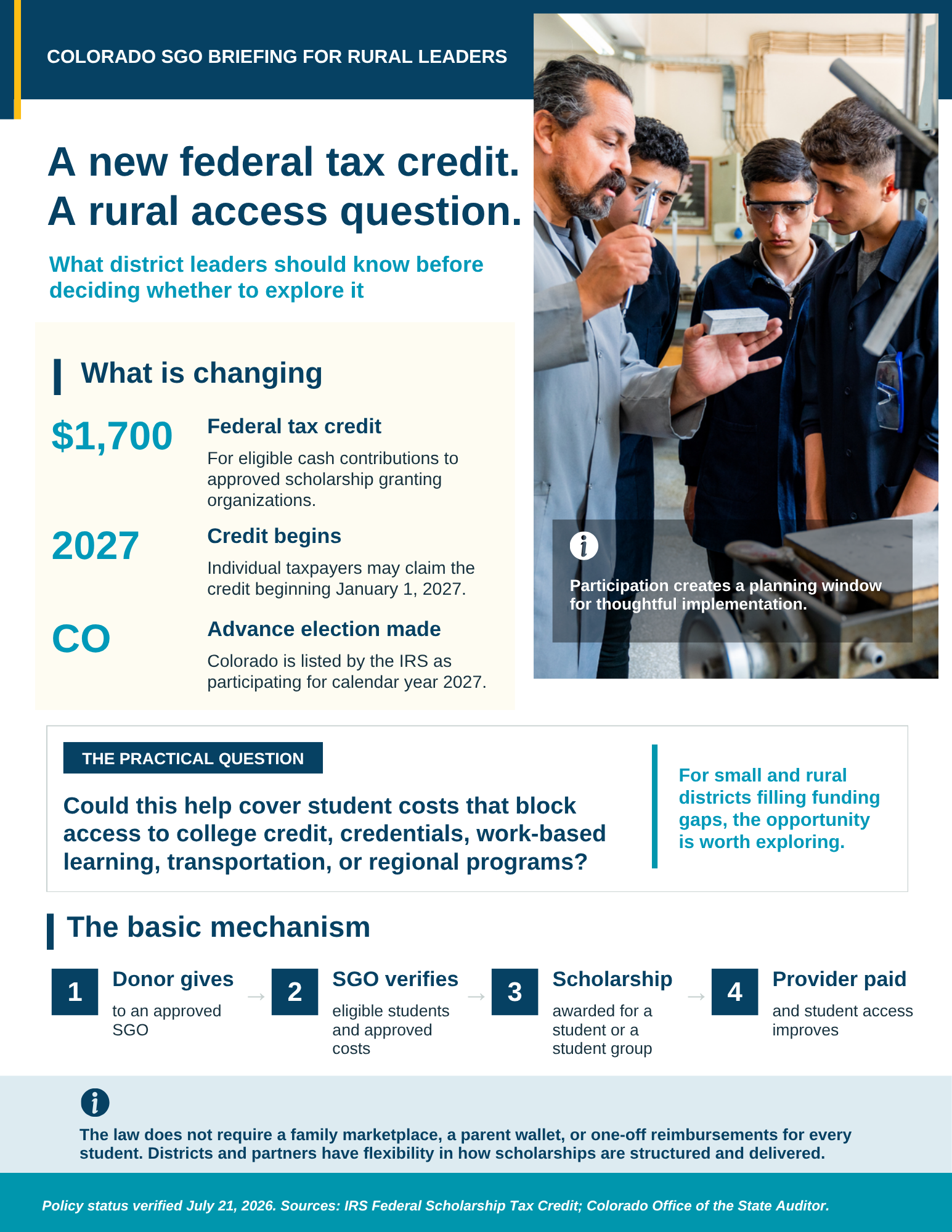
Beginning in 2027, individuals can claim up to $1,700 in federal tax credit for donations to eligible scholarship-granting organizations, or SGOs. Colorado has opted into the program, creating potential opportunities for public school districts, including small and rural districts.
This briefing explores how rural education leaders could use SGOs to address student access barriers, support locally defined priorities, and build additional capacity through regional and community partnerships.
-
How money could flow from donors through an SGO to districts or approved providers
Why districts should think of an SGO as a fundraising platform rather than a source of isolated reimbursements
How an SGO could support college credit, industry credentials, work-based learning, and other priorities
What rural districts should consider when deciding whether to build an SGO, partner with one, or share regional infrastructure
Why employers, alumni, BOCES, foundations, chambers of commerce, and other community partners could play important roles
What Colorado education leaders know about the state’s anticipated implementation process
-
00:00 | Introduction and why this matters
Sara Butler explains the new federal tax credit, Colorado’s decision to participate, and why rural education leaders should begin exploring the opportunity now.02:00 | How SGO funding works
Antonio Parés explains the basic funding flow and how an SGO could verify student eligibility, approve costs, and pay districts or providers.03:00 | Thinking like a fundraiser
Districts can identify a priority, organize a local campaign, engage donors, and use an SGO as the financial platform.04:00 | Applying the model to the Big 3
The conversation explores how one campaign could support costs connected to college credit, industry credentials, and work-based learning.05:00 | Identifying student access barriers
Potential barriers include exam fees, dual-enrollment costs, course materials, credential exams, safety equipment, transportation, and regional pathway programs.06:00 | What this could mean for rural districts
Brad Mitchell discusses rural donor bases, shared administrative capacity, regional partnerships, provider supply, and the possibility of using SGOs to strengthen local systems.09:00 | Why Colorado opted in
Tammi Hiler explains the state’s decision, the potential benefit for public school students, and why the tax credit is considered supplementary to existing Colorado education funding.12:00 | The role of employers and civic partners
Shannon Nicholas discusses how employers can serve as donors, champions, and partners working to strengthen regional talent pipelines.13:00 | Closing headlines from the speakers
Each speaker shares the central message they want rural education leaders to remember.15:00 | Questions and next steps
The briefing closes with questions districts and regional partners can use to begin exploring the opportunity. -
What student costs currently prevent young people from accessing important opportunities?
Which college, career, and workforce opportunities matter most in your community?
Should your district build an SGO, partner with an existing organization, or explore shared regional infrastructure?
Which foundations, BOCES, employers, providers, civic organizations, and neighboring districts should be part of the conversation?
Who understands your local context and can help your community evaluate or develop an effective approach?
-
Sara Butler
State Director, Colorado
Empower SchoolsAntonio Parés
Walnut Hill WorkshopBrad Mitchell, PhD
Strategic Advisor
Generation Schools NetworkTammi Hiler
Special Advisor, K-12 and Early Childhood to Governor Jared Polis
State of ColoradoShannon Nicholas
Senior Vice President of Impact
Colorado Succeeds